
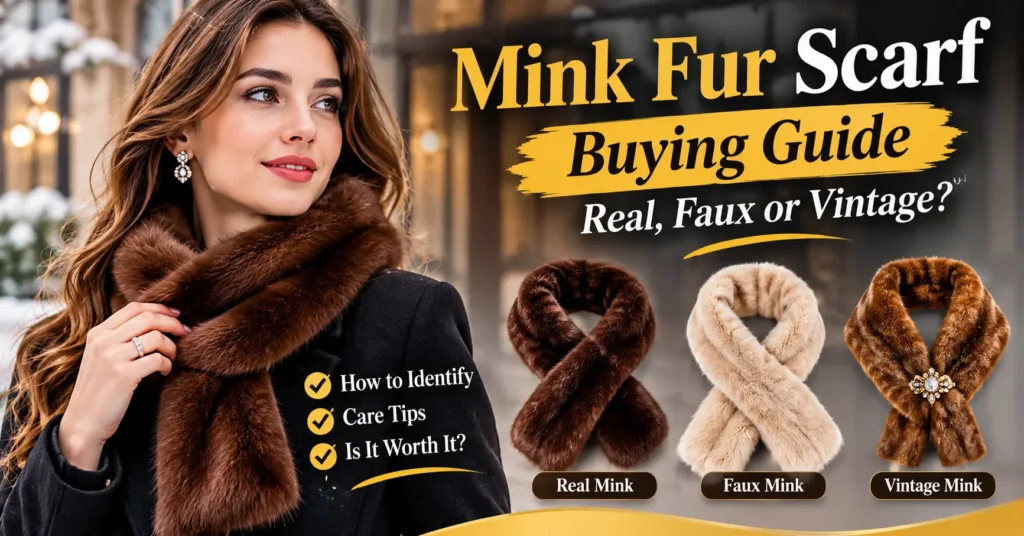

A mink fur scarf is a narrow neck wrap made from mink pelts, and there are really three ways to buy one: new and real, faux, or vintage. A real mink scarf is the softest of the lot and can last for decades if you treat it well, but it costs the most. A faux mink scarf is the easy, cheaper option. A vintage mink scarf can get you the real thing for much less, provided the pelts haven’t dried out. The right pick depends on your budget and how often you’ll actually wear it, so let’s work through it.
What Is a Mink Fur Scarf?
A mink fur scarf is a slim strip of mink that wraps around your neck, and it works over a winter coat just as well as with a dress. Some are made by sewing pelts together end to end. Others are knitted from thin strips of fur, and those hang much softer. Mink is the favorite here because the fur is short, dense and glossy, so it looks sleek instead of big and bulky.
Don’t be thrown by the names, either. Sellers call the same thing a mink wrap, a mink collar or a mink neck wrap, so search a few ways before you decide nothing’s out there.
Mink Fur Scarf vs Mink Stole: What’s the Difference?
The quick answer is width. A scarf is narrow and stays at the neck. A mink stole is wider and longer, and it’s meant to drape over your shoulders and hang down the front. Sellers mix the two up constantly, so ignore the title of the listing and check the measurements.
- Scarf: slim, focused on the neck and easy to wear daily
- Stole: wide, sits on the shoulders and suits formal evenings better
- Shawl: usually the widest, closer to a small wrap
What Are Fur Scarves Called?
If you’re hunting through antique shops or auction sites, you’ll see older words too. A tippet is a short fur cape for the shoulders, a muffler is a thick tube, and a boa is a long soft strip. They’re not obvious, but knowing them keeps you from scrolling past the right piece.
Real vs Faux Mink Scarf: Which One Should You Buy?
There isn’t one right answer here, because each option is good at something different. A real mink scarf is softer, heavier and warmer, and if it gets damaged, a furrier can usually fix it. A faux mink scarf is much cheaper and easier to clean, and no animal is involved.
A few questions can settle it quickly:
- How often will I wear it? Daily use points to faux, while an occasional dress piece can justify real.
- Does animal fur sit right with me? That’s a perfectly good reason to skip real mink, and faux fur looks much better than it did a decade ago.
- Will I look after it? Real fur needs proper storage and professional cleaning.
How to Tell a Real Mink Scarf From a Fake One
Don’t trust the label on its own, since animal protection groups have found real fur sold as faux. Check the piece itself instead. It works in a shop, and it works on that box of old things from a relative too:
- Part the fur and look at the base. Real fur grows from thin leather like skin, while faux fur sits on woven or knitted fabric.
- Check the hair tips. Real hairs usually taper to a fine point and faux hairs tend to be blunt, although sheared fur can fool you here.
- Look for variety. Real fur has hairs of different lengths over a soft undercoat, and faux often looks too even.
- Feel the weight. Genuine pelts are usually heavier than synthetic ones.
The Touch Test: Soft Pelt Backing vs Stiff Fabric
Push your fingers through the fur and press down near the base. A real pelt feels soft and bendy, a little like thin suede, and faux backing feels like cloth. If the seller is okay with it, push a pin through a hidden spot. Skin fights back a bit, but fabric lets the pin right through.
Why a Very Cheap Mink Fur Scarf Is a Red Flag
Real mink takes a lot of pelts and skilled hands, so a brand new “real” mink fur scarf at a suspiciously low price deserves a hard look. It might be faux, it might be poor quality, or the listing might just be dishonest. Used is the exception, because secondhand prices really are low, and the cost section shows how low.
When a Faux Mink Scarf Is the Smarter Pick
I’d go faux if you want a bold color, plan to wear it hard, or live somewhere new fur can’t be sold. A good faux mink scarf also spares you the storage and cleaning costs. It does run a bit cooler than real fur in serious cold, since real fur has that thick undercoat, but in a normal city winter you won’t feel the difference.
Vintage Mink Fur Scarf: Is a Secondhand Piece Worth It?
Often, yes. A vintage mink scarf or stole from the 1940s to 1960s can be really well made, and it usually costs far less than a new one. Resale prices follow age, style and condition, not what the first owner paid. The risk is condition. Old pelts dry out and split, and a bargain with cracked leather isn’t a bargain.
What to Check Before Buying a Vintage Mink Scarf
Treat it like a used car and look it over properly. Squeeze the fur, smell it, flip it to see the underside, and ask if anyone ever had it cleaned or stored the right way.
Pelt Condition, Lining and Clasps
- Bend the pelt gently. It should flex, not crackle or tear.
- Smell it. A strong musty or chemical odor is hard to get rid of.
- Check the lining for rips, stains and loose stitching.
- Test the clasps, hooks or clips so the scarf stays put when you move.
Mink Scarf With Head: Quirky or Outdated?
Plenty of older pieces, including mink stoles with heads, keep the head and tail as decoration. Some people love the retro drama and others find it a bit unsettling. Make up your mind before you buy, because getting the heads removed is usually a furrier’s job.
Where to Find Secondhand Mink Pieces
You’ll find them at estate sales, vintage shops, resale furriers and online marketplaces. A search for mink stole for sale turns up plenty of listings, but read the seller’s policies first, because some marketplaces limit fur. And before you pay, ask for clear photos of the backing and the lining.
How Much Does a Mink Fur Scarf Cost?
A new real mink piece costs a lot more than faux, and the price moves with pelt quality and maker, so ask a furrier for a current quote. Used is a different story. Used mink coats often sell for roughly $100 to $1,500. In the resale data I checked, many vintage stoles went for well under $100, and a few special ones reached several hundred. Set that against premium new coats at $8,000 or more and you can see how fast mink loses value once someone else owns it.
What Changes the Price: Pelt Quality, Length and Age
- Pelt quality: dense, even, glossy fur costs more than dry or patchy fur
- Length and width: more pelts mean a higher price
- Age and style: classic cuts hold their value but dated ones don’t
- Condition: dryness, odor and damage can cut the value sharply
- Upkeep: budget roughly $95 to $150 for a professional cleaning, plus storage
Is Your Old Mink Stole Worth Anything?
An insurance appraisal tells you what it would cost to replace the piece, and that figure can sit far above what a buyer will really pay. So to get a realistic read on the value of a mink stole, ask for a resale estimate, look at recent sold listings, and get a second opinion from a fur dealer.
Mink Fur Scarf Styles: Narrow, Knitted and Infinity
Beyond the classic pelts sewn in a line, a few styles are worth knowing:
- Narrow scarves: sleek and easy to wear under a coat collar
- Knitted mink scarf designs: thin strips of fur worked into a flexible, drapey band
- Fur infinity scarf loops: no ends to tuck, which suits casual wear
- Long scarves: wrap them twice when it’s really cold
Popular Colors: Black, White, Grey and Brown
Brown and dark mahogany are the classics. Black goes with almost anything, and grey and white feel lighter and a bit more modern. A black fur scarf or a brown one suits most coats. White, though, shows marks sooner.
Mink Scarf for Men and Women
A mink scarf for men is usually plain and dark, and it sits well under a wool overcoat. Women’s styles tend to run wider and lighter in color. Whichever one you land on, get a length that works for your height and the way you actually wear a scarf.
How to Wear a Mink Fur Scarf With Coats and Dresses
Let the fur be the star and keep everything else quiet.
- With a wool coat: drape it loosely and tuck the ends in
- With a dress: wear it as an evening wrap and fasten it at the front
- With a fur coat: usually skip it, or pick a smooth silk scarf in a matching tone
- With a bag: avoid shoulder straps because they can break the hairs and leave bald patches
If you’re wondering what scarf goes with a mink fur coat, I’d say plain silk or cashmere, since fur on fur gets busy fast.
Is It Legal to Buy a Mink Fur Scarf? Plus Care Tips
California has banned the sale of new fur since January 2023, and a handful of Massachusetts towns, including Wellesley, Brookline and Cambridge, have followed. Secondhand fur is generally exempt. Still, these laws keep shifting, so check your own area before you buy.
A little care goes a long way with real fur:
- Store it in a breathable cotton bag, never plastic
- Keep it somewhere cool, dark and away from humidity
- Skip home washing since a furrier should clean it
- Think about seasonal cold storage for valuable pieces
Mink Fur Scarf FAQs
What is a mink stole?
A mink stole is a wide wrap of mink fur that drapes across the shoulders, usually for evenings or formal events. It’s wider and longer than a scarf.
How much is a real mink scarf worth?
It depends on condition, age and maker. Used pieces often sell for under a couple of hundred dollars, while new ones cost a lot more. And an appraisal can come in higher than what anyone will actually pay on resale.
Is a faux mink scarf as warm as real mink?
Usually a little less in extreme cold because real mink has a dense undercoat. A good faux scarf is still plenty warm for most winter days.