
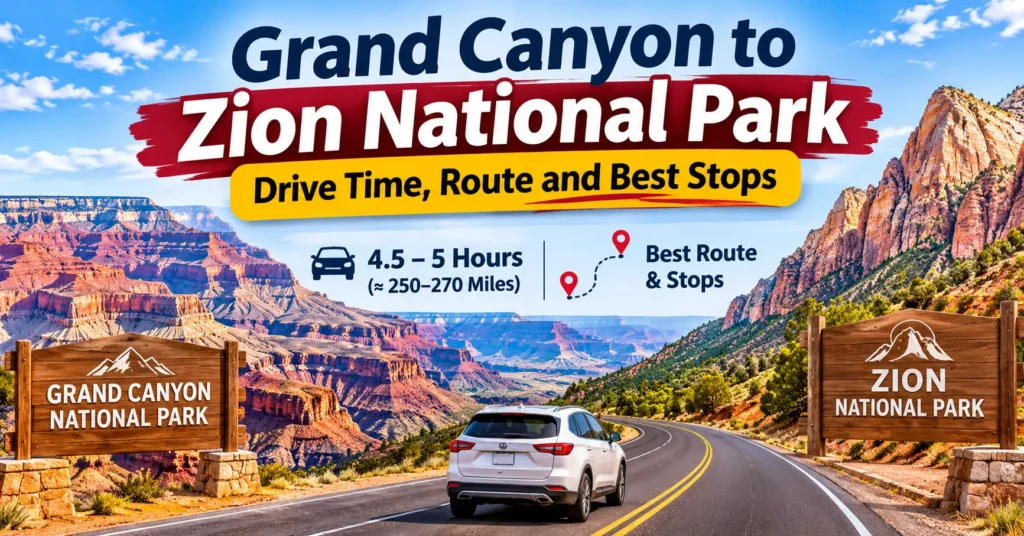

The Grand Canyon to Zion National Park drive takes four and a half to five hours from the South Rim, roughly 250 to 270 miles. A lot of people cram it into one day, and honestly I get why. I just think most of them end up tired and a bit disappointed, so this post is my attempt to help you plan it better.
You’ll get the route, the rim question, what to see before you leave, where to sleep, a simple two day plan and what it all costs. Fees and dates change, so keep the Grand Canyon National Park page and the Zion National Park page open while you plan.
How Long Does the Drive Really Take?
Plan for six hours. That four and a half hour figure is the one Google Maps gives you when you never stop, which isn’t how anyone drives this road. You’ll fill up the tank, eat lunch way later than you meant to, and pull over at some viewpoint on US 89 because the rocks look great in that light. All of that adds up fast on a Grand Canyon to Zion National Park day.
Here are the numbers without stops, rounded:
- South Rim to Zion: about 250 to 270 miles, 4.5 to 5 hours
- North Rim to Zion: about 130 miles, 2.5 hours
- Las Vegas to Zion: about 160 miles, 2.5 hours
- Phoenix to the South Rim: about 230 miles, 3.5 hours
Gas matters more than you’d think. Some stretches are properly empty, and a station that looks open in your app can turn out to be shut. Top up when you see one.
Leaving From the South Rim: The Usual Route and Timing
The usual route runs east on Arizona 64 to Cameron, north on US 89 through Kanab, then west on Utah 9 into Zion. Cameron has an old trading post with a restaurant, so it’s an easy place to eat and fuel up at once. Want Horseshoe Bend? Route through Page yourself, because your app won’t always pick it.
If you leave by eight, you’ll be in Zion by mid afternoon.
Watch the time zones, because they’ve cost people tours. Most of Arizona ignores daylight saving and Utah doesn’t, so in summer a 2 pm Utah booking is 1 pm on your Arizona watch. Read the confirmation email twice.
Can You Do the Grand Canyon to Zion National Park Drive in One Day?
You can, as a travel day. Spend the morning at the South Rim, drive after lunch and have dinner in Springdale. Seeing both parks properly in that same day is a different story, and it doesn’t work. You’d skim both and remember neither. With only one day, choose one park and let the other go by through the windshield.
Zion National Park to Grand Canyon: Driving the Route in Reverse
Everything works the same going backwards. Zion National Park to Grand Canyon is the easier order if you flew into Las Vegas, since Zion is about two and a half hours from there, and our Las Vegas to Zion road trip guide covers that first leg. Start early in Zion because it’s packed by mid morning, then drive east and aim to reach the South Rim for sunset.
Grand Canyon to Utah: South Rim or North Rim, Which Is the Better Starting Point?
So, where is the Grand Canyon located? In northern Arizona, which means Grand Canyon to Utah involves crossing a state line at some point. Which rim you start from changes the whole day. On a map the rims look like neighbors, about ten miles apart across the canyon, but by road you’re looking at more than 200 miles between them.
A few amazing facts about the Grand Canyon explain why the two rims feel so different. The canyon runs about 277 miles, and how wide is the Grand Canyon depends on where you’re standing, from a few miles to roughly 18. Grand Canyon depth goes past a mile, around 6,000 feet at the deepest. With numbers like that, it’s no surprise the rims feel like two different places.
Starting at the South Rim: Easier Access, Longer Drive
The South Rim is open all year, and it has the most places to stay. There’s a free shuttle too, and both Flagstaff and Phoenix make it easy to reach. The one weakness for this trip is distance, because you’ll drive close to five hours before Zion appears.
Starting at the North Rim Near Bright Angel Point
The North Rim is cooler and quieter. The Grand Canyon altitude at the North Rim is around 8,000 feet, about 1,000 feet above the South Rim, so the air is thinner and even short walks can leave you a little out of breath. It’s also seasonal, with most services running from about mid May to mid October, so check dates before you plan around it. The classic first stop is Bright Angel Point on the North Rim, a paved walk of about half a mile with steep drops on both sides. Most people are fine on it. If you have small kids, hold their hands.
Does the North Rim Make the Drive Shorter?
By a lot, yes. It’s about two and a half hours to Zion through Fredonia and Kanab. Here’s the thing, though: the North Rim is far from any big airport. Which means the shorter drive only really pays off if the North Rim was already on your list.
Things to Do at the Grand Canyon South Rim Before You Leave
Most people rush through the South Rim because there’s a long drive waiting. I’d rather you gave it a slow morning, even a short one. If you’re wondering what to do in the South Rim of the Grand Canyon with limited time, a few good viewpoints beat a packed checklist.
What to See at the South Rim in One Morning
If you’re picky, the best things to do in Grand Canyon South Rim fit into one morning. Begin at Mather Point, right next to the visitor center, then catch the free shuttle to Yavapai Point. That’s where the view starts stretching out along the rim. Leaving by the east entrance? End at Desert View Watchtower, out on the east rim of the Grand Canyon. It’s a stone tower finished in 1932 and designed by Mary Colter. You can climb it for a view toward the Colorado River, and it’s right on your way out. That’s about as much as what to see at the Grand Canyon South Rim needs to be when you’re short on time.
Reading the Grand Canyon National Park South Rim Map So You Don’t Waste Your Morning
Pick up a paper map at the entrance, or download the NPS app before you drive in, because your signal will come and go. On the Grand Canyon National Park South Rim map, the shuttle routes are color coded. Take two minutes to see how they connect and you won’t have to hunt for parking, which by late morning is mostly a lost cause.
Viewpoints Worth Your Time Before You Leave
Mather Point is the big first look, Yavapai has the long view, and Desert View has the tower. If you have to skip one, skip whichever is most crowded when you arrive. Past the viewpoints, one of the easiest things to do on the South Rim of the Grand Canyon is a short walk along the Rim Trail. It’s mostly flat, with some paved stretches.
Stops Worth Making Along the Way
You don’t need many stops on a Grand Canyon to Zion National Park drive, only a couple.
Horseshoe Bend and Page: Worth the Stop or Not?
Horseshoe Bend is a mile and a half round trip with almost no shade and a parking fee, and on summer afternoons it’s hot and crowded. Bring water. If you’re already in Page, 45 minutes is plenty. I wouldn’t drive extra miles for it, though. Antelope Canyon works differently, since you can only go with a guided tour and the better time slots book out early.
Kanab: The Easiest Place to Stretch Your Legs
Kanab is a small Utah town about an hour from Zion’s east entrance. It has gas, coffee and a few places to eat, and most drivers stop here before the final stretch. That’s really all there is to say about it.
Three Quick Pull Offs If You Have Time
Just past the east entrance of the Grand Canyon, the Little Colorado River Gorge overlook sits right off Arizona 64, with Navajo vendors selling jewelry along the rim. It takes ten minutes and costs a few dollars. If you take the Marble Canyon route instead of going through Page, Navajo Bridge is worth a stop for the walk out over the Colorado River. And near Zion’s east entrance, the Checkerboard Mesa pullout on Utah 9 is a free photo stop with no hiking.
Is a Detour Worth It?
It depends on your time. With one day, skip it and drive straight through. With two or more, add Horseshoe Bend and take it easy.
Where to Stay Before You Hit the Road
Flagstaff and the Grand Canyon: Is It a Good Base?
A lot of people end up choosing a Flagstaff Grand Canyon stay, and it makes sense. The town has more restaurants and cheaper hotels than the park, and the South Rim is only about 80 miles away, so call it an hour and a half. It works well if you’re flying into Phoenix. What you lose is that drive, twice a day, and it also points you away from Zion. Our Flagstaff hotel guide lists a few options by budget.
The Closest City and Closest Airport to Grand Canyon National Park
The closest town to the South Rim is Tusayan, a few miles from the entrance, with hotels and restaurants. If you’re asking about the closest city to Grand Canyon, that’s Williams, about an hour away, while Flagstaff is bigger and a bit farther. Williams is also the nearest city to Grand Canyon with a train station, since the Grand Canyon Railway starts there. Between Tusayan, Williams and Flagstaff, those are the Grand Canyon cities and towns you’ll realistically sleep in.
The closest airport to Grand Canyon National Park is a tiny one in Tusayan, and it mostly handles sightseeing flights, so it’s not much help for getting there. Almost everyone flies into Phoenix or Las Vegas and drives the rest. From Phoenix it’s about three and a half hours, and from Las Vegas it’s closer to four and a half.
Flagstaff or a Closer Town: Which Base Fits Your Plan?
If you want sunrise at the rim, stay in the park or in Tusayan and book months ahead, since rooms inside the park fill up fast. If price and dinner options matter more to you, Flagstaff is the better pick.
Coming From Tucson or Lake Havasu?
Not everyone starts from Phoenix or Las Vegas. Tucson, AZ to Grand Canyon is a long day, about six hours to the South Rim, so most people break it up with a night in Flagstaff or Williams. Lake Havasu to Grand Canyon is shorter, about four hours, and the road through Kingman and Williams is easy. Either way you’re adding a day before the Zion leg, so count that in when you build your schedule.
When Is the Best Time to Make the Drive?
Spring and fall, with fall slightly ahead. April, May, late September and October give you comfortable days at both parks without the summer crush. Summer is the hard one. Zion Canyon often hits 100 degrees or more in July and August, and the rim at the Grand Canyon is cooler, so you’ll feel the swing as you drive between them.
Winter has its own appeal, with fewer people and snow on the rim. Days are short though, the North Rim is closed, and I wouldn’t plan a long desert drive that ends after dark.
A Simple Two Day Plan
Day One: South Rim in the Morning, Zion by Evening
Take it slow at Mather Point and Yavapai, then head out through Desert View around ten. Eat in Cameron or Page, give Horseshoe Bend 45 minutes if you went that way, and fuel up in Kanab. Aim to reach Springdale in time for dinner, and don’t plan anything after it. You’ll be tired.
Day Two: Zion Before the Crowds
Catch one of the first shuttles into the canyon, because in busy months the main Zion road is shuttle only. The Riverside Walk is easy, paved and shaded in places, and Emerald Pools is a bigger effort if you’ve got energy. Angels Landing needs a permit, so don’t count on it. By the afternoon you can head to Las Vegas, which is under three hours away.
Fees, Passes and Camping for a Grand Canyon to Zion National Park Trip
Both parks charge $35 per vehicle, good for seven days, and each park collects its own fee. If you live in the US, that’s the whole bill. The annual America the Beautiful pass costs $80 for residents, and with two parks at $35 each you only come out ahead once you add a third.
International visitors pay more. Since January 2026, anyone aged 16 or older who doesn’t live in the US pays an extra $100 per person at 11 parks, and both the Grand Canyon and Zion are on the list, along with Bryce Canyon. It’s per park and per person, so it adds up quickly:
- One person in a rental car, both parks: about $270 without a pass
- Two adults in one car, both parks: about $470 without a pass
- Two adults and two kids under 16, both parks: about $470 without a pass
The nonresident annual pass is $250, and it covers the pass holder plus everyone riding in the same private vehicle. A lawsuit challenging the fee was filed this fall, so check nps.gov before you pay anything.
Grand Canyon National Park Passport and Annual Pass: What You Actually Need
These two get confused a lot. The America the Beautiful annual pass gets you into national parks for a year, and you can buy a digital one on Recreation.gov. Save the QR code before you leave, since signal is patchy near the parks. The Grand Canyon National Park passport is a different thing: a stamp book for collecting cancellation stamps at visitor centers. Nice keepsake, but it won’t get you through the gate.
Campground Fees at the Grand Canyon, Zion and Bryce
Mather Campground at the South Rim and Watchman at Zion both book through Recreation.gov, and the good dates disappear months ahead, so don’t leave it to the last week. Campground prices change with the site and the season, so check the nightly rate on the listing itself rather than trusting a number from a blog, this one included. Want Bryce Canyon too? It’s about an hour and a half from Zion, and it means a third campground to book. If Zion is your main stop, our Zion hiking guide shows which trails are worth your time.
Is a Park Pass Worth It for This Route?
For US residents, barely. Two parks cost $70 and the pass costs $80, so it only pays off if you add Bryce or another park. For international visitors it’s a different story. The $250 pass beats paying at the gate even for a solo traveler visiting both parks, and for couples and families it’s a much better deal.
Planning From Abroad: Visas, Driving and Food
Coming from outside the US? Get the paperwork out of the way first, because it’s way easier to fix at home than at a rental counter in Las Vegas.
The visa is the big one. If your passport is from a visa-waiver country, you can usually get by with an ESTA, which takes a few minutes online. If it isn’t, you’ll need a B1/B2 visitor visa, and that’s a proper process: an application, a fee and an interview at the embassy. How long you wait for that interview depends a lot on where you’re applying, and in some cities it’s months. Look up the current wait on travel.state.gov before you settle on dates. I’d hold off on booking flights until the visa is in your hands, and since the rules shift a lot, trust that site over any blog, mine included.
Driving here is easier than you’d think. The roads are wide and clearly signed, though you’ll have long stretches with nothing but desert around you. Cars keep to the right, gas is sold by the gallon, and stations can be a long way apart, so top up whenever you pass one. Some rental companies want an International Driving Permit along with your home license and some don’t. Just ask. It costs little and saves you an awkward moment at the counter.
Time zones will trip you up. Most of Arizona skips daylight saving, Utah doesn’t, and the Navajo Nation (Cameron and the Antelope Canyon area) has its own setup. If you’ve booked a tour, message the operator and confirm what time they mean.
Food takes a bit of planning in the small towns. Tusayan and Kanab don’t have much choice, so if you’re vegetarian, eat halal or have other dietary needs, look up places in Flagstaff, Las Vegas or St. George on Google Maps ahead of time. Keep snacks in the car too. You’ll want them somewhere around hour three.
One last thing: download everything before you leave. Offline maps, your park pass QR code, your bookings. Signal disappears near both parks.
Quick Answers Before You Book Anything
How Many Hours Is the Drive From Grand Canyon to Zion National Park?
About four and a half to five hours from the South Rim without stops, and about two and a half hours from the North Rim.
Is the Drive Easy in Winter?
Mostly. Snow and ice can appear on the highways around Kanab and on Utah 9 near Zion, and the North Rim is closed for the season. The last stretch into Zion goes through the Mount Carmel tunnel, about a mile long, and an RV or anything tall needs a permit and an escort fee there. Sort that out before you arrive.
Which Is Better to Visit First, the Grand Canyon or Zion?
Whichever is closer to your airport. If you fly into Phoenix, go to the Grand Canyon first. If you fly into Las Vegas, start with Zion.
Do I Need Separate Tickets for Each Park?
Yes, each park collects its own entrance fee, or you show an annual pass. Popular hikes like Angels Landing in Zion need a permit, so check nps.gov before you go.
Is There an Extra Fee for International Visitors?
Yes. Visitors aged 16 or older who don’t live in the US pay $100 per person at both parks, on top of the vehicle fee, unless they hold the $250 nonresident annual pass.
What I’d Do Differently Next Time
If I did the Grand Canyon to Zion National Park trip again, I’d leave the South Rim earlier, stop at Desert View on the way out and give Zion two nights instead of one. Horseshoe Bend, Antelope Canyon and Bryce in one day sounds amazing on paper. You’ll end up spending more time in the car than at the parks, and I wouldn’t do that to myself twice.